Short answer
Time in range rarely moves because of one heroic day. It moves when a few repeatable behaviors stack: timing mealtime insulin the way your care team taught you, putting carbs later on the plate, walking after dinner, treating lows without stacking, protecting sleep, reviewing patterns weekly, and turning one goal into one behavior. Pick one. Give it two weeks.
This article expands the Glynce Instagram carousel of the same name. It is education for adults with type 1 diabetes, not a dosing guide and not a first-aid protocol. Glucose values use mmol/L where numbers appear.
In this article
- What “habit” means for TIR
- 01 Take your insulin before you eat
- 02 Save the carbs for last
- 03 Walk ten minutes after dinner
- 04 Treat the low, then pause
- 05 Go to bed at the same time
- 06 Check your patterns once a week
- 07 Pick one goal and make it a behavior
- How Glynce helps
- FAQ
- What you can do this week
What “habit” means for TIR
Time in range (TIR) is the share of CGM readings in your target band over days or weeks. A single dinner does not define it. Repeating friction does: late boluses, carb-heavy first bites, sitting still after the biggest meal, overtreating lows while the sensor lags, chaotic sleep, and reacting to every ping instead of looking for patterns.
Habits beat intensity. You do not need all seven at once.
01 Take your insulin before you eat
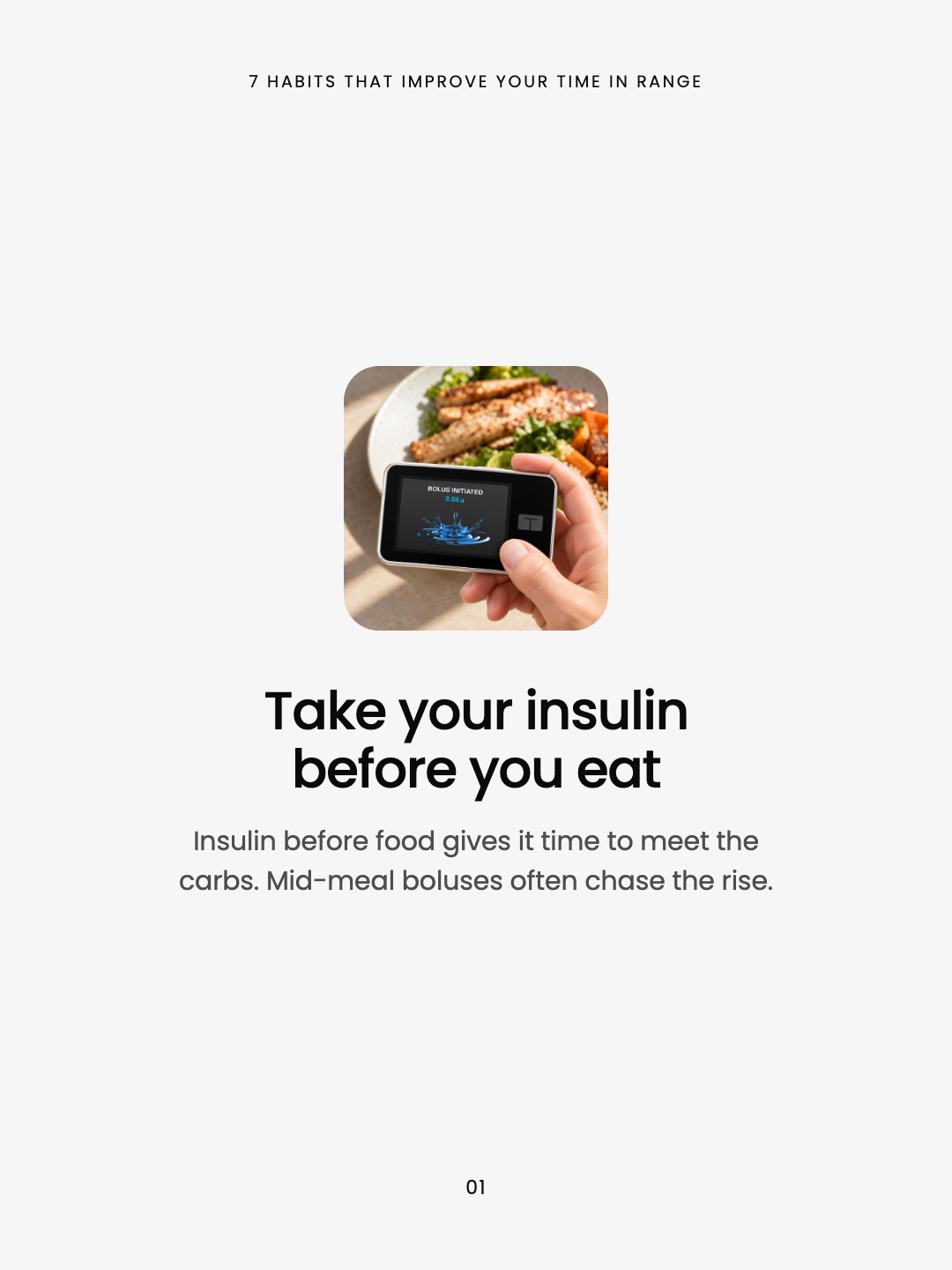
Carousel line: Insulin before food gives it time to meet the carbs. Mid-meal boluses often chase the rise.
Rapid-acting insulin needs time to start working. If carbohydrate hits your bloodstream first, the CGM often climbs while insulin is still catching up. Many people find that taking mealtime insulin before the first bite, when that matches the plan from their care team, softens the early post-meal rise compared with bolusing halfway through the plate.
This is individual. Gastric emptying, meal composition, closed-loop settings, and hypo risk all matter. Some meals (high fat, slow digestion) need different timing strategies entirely. Talk timing with your care team before you change anything. This article will not tell you how many minutes or how many units.
02 Save the carbs for last
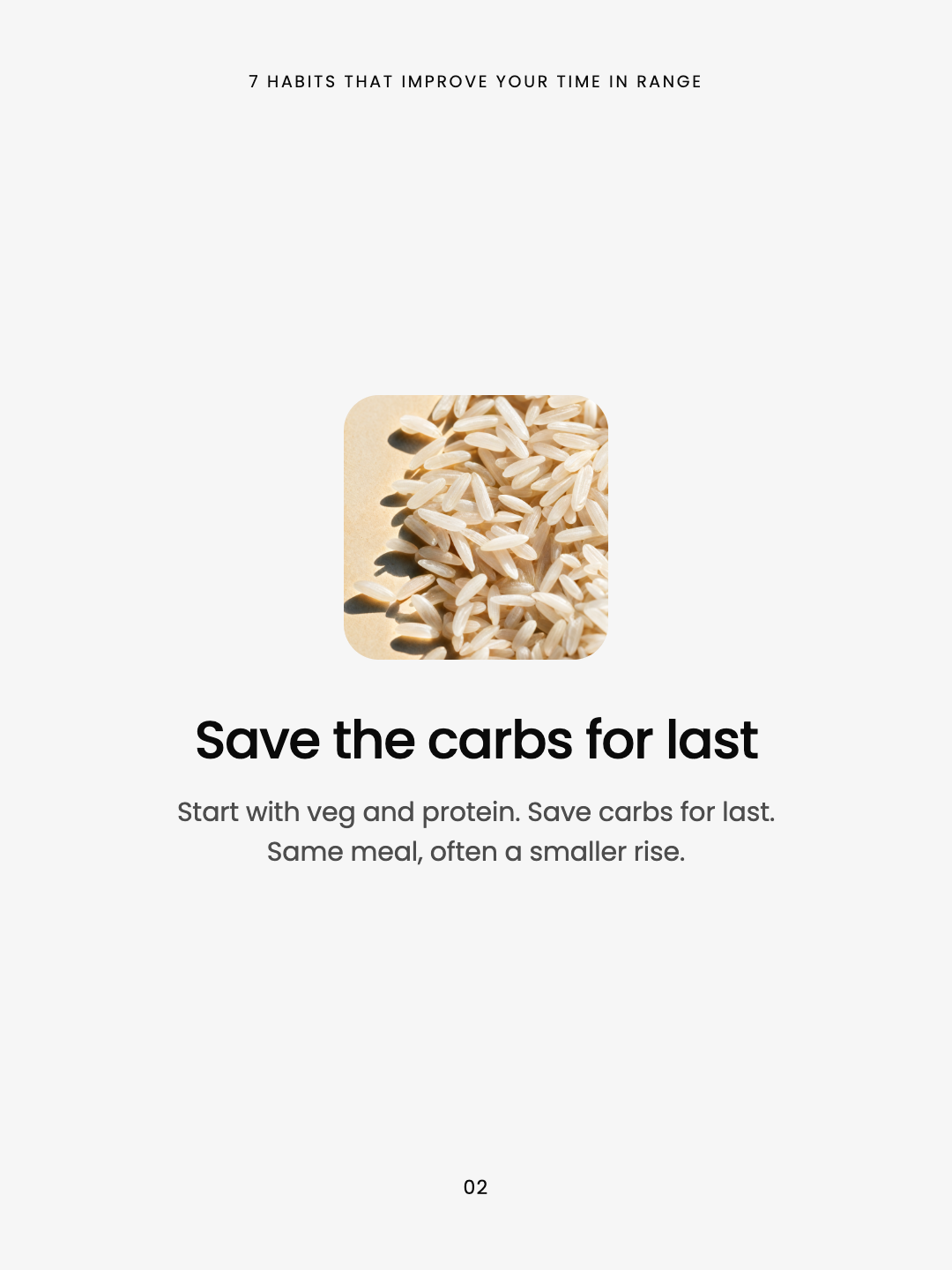
Carousel line: Start with veg and protein. Save carbs for last. Same meal, often a smaller rise.
Same food, same insulin plan, different order. Starting with vegetables and protein, and saving bread, rice, or pasta for the end, can slow how fast glucose appears after the meal for some people.
In a small randomized crossover study in children and teens with type 1 diabetes, eating protein and fat before carbohydrate was linked to lower average post-meal glucose and less time above high thresholds than eating the same nutrients together. That is one study, in a younger group, not a guarantee for every adult meal. Treat it as a low-cost experiment you can see on your own CGM: same recipe, carbs last, compare curves.
You do not need extra insulin for the plate order itself. Dosing still belongs with your care team and your usual method.
03 Walk ten minutes after dinner
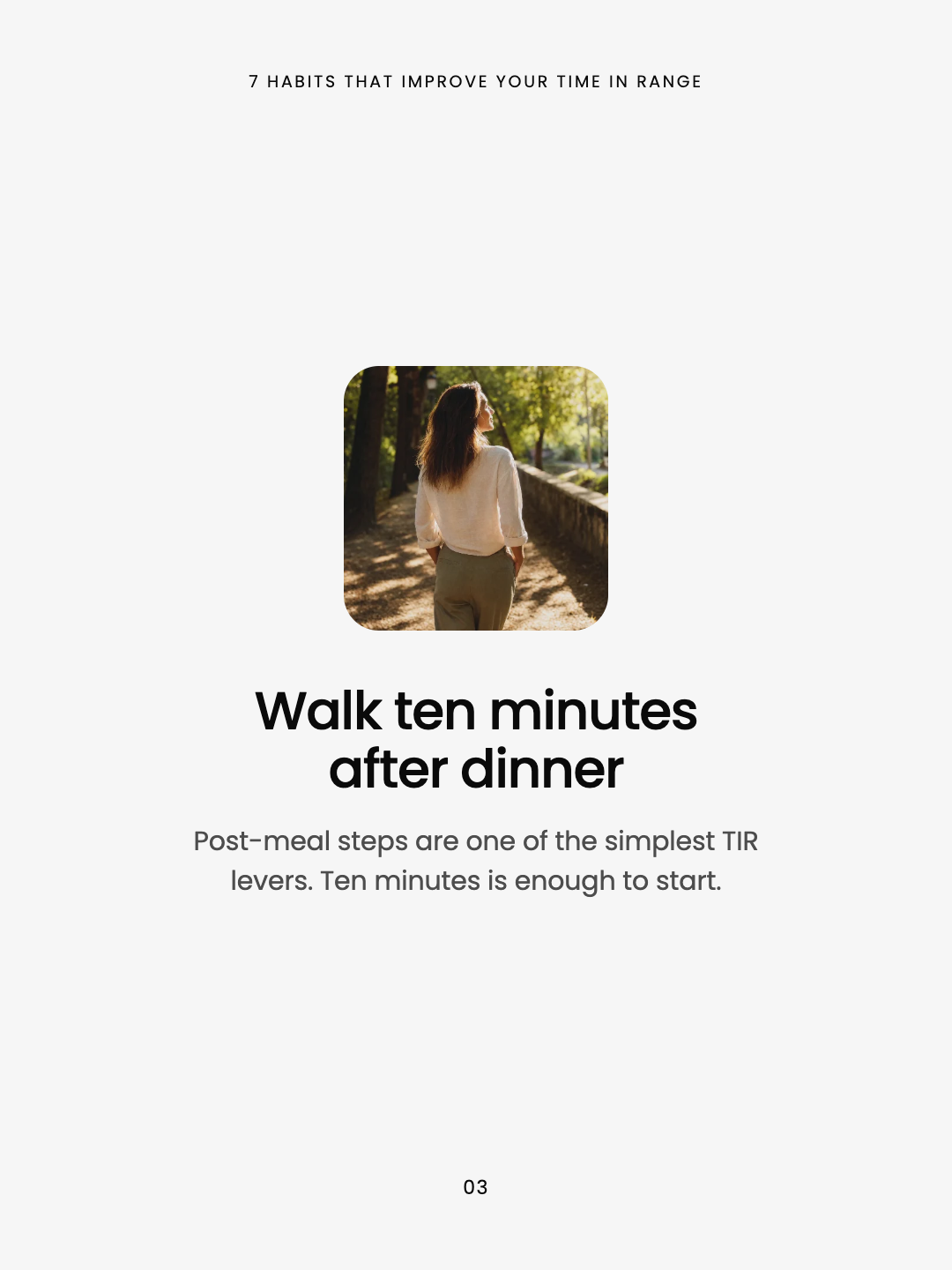
Carousel line: Post-meal steps are one of the simplest TIR levers. Ten minutes is enough to start.
Working muscle can take up glucose with less reliance on insulin. A short walk after your biggest meal is often enough to blunt the post-meal rise.
Evidence for post-meal walking is strongest around meal timing in general (including type 2 and at-risk groups): activity soon after eating tends to reduce postprandial glucose more than the same activity before the meal. For type 1, the principle is practical and widely used: move after you eat, watch your own curve, and account for hypo risk if you are active on insulin. Ten minutes around the block counts.
04 Treat the low, then pause
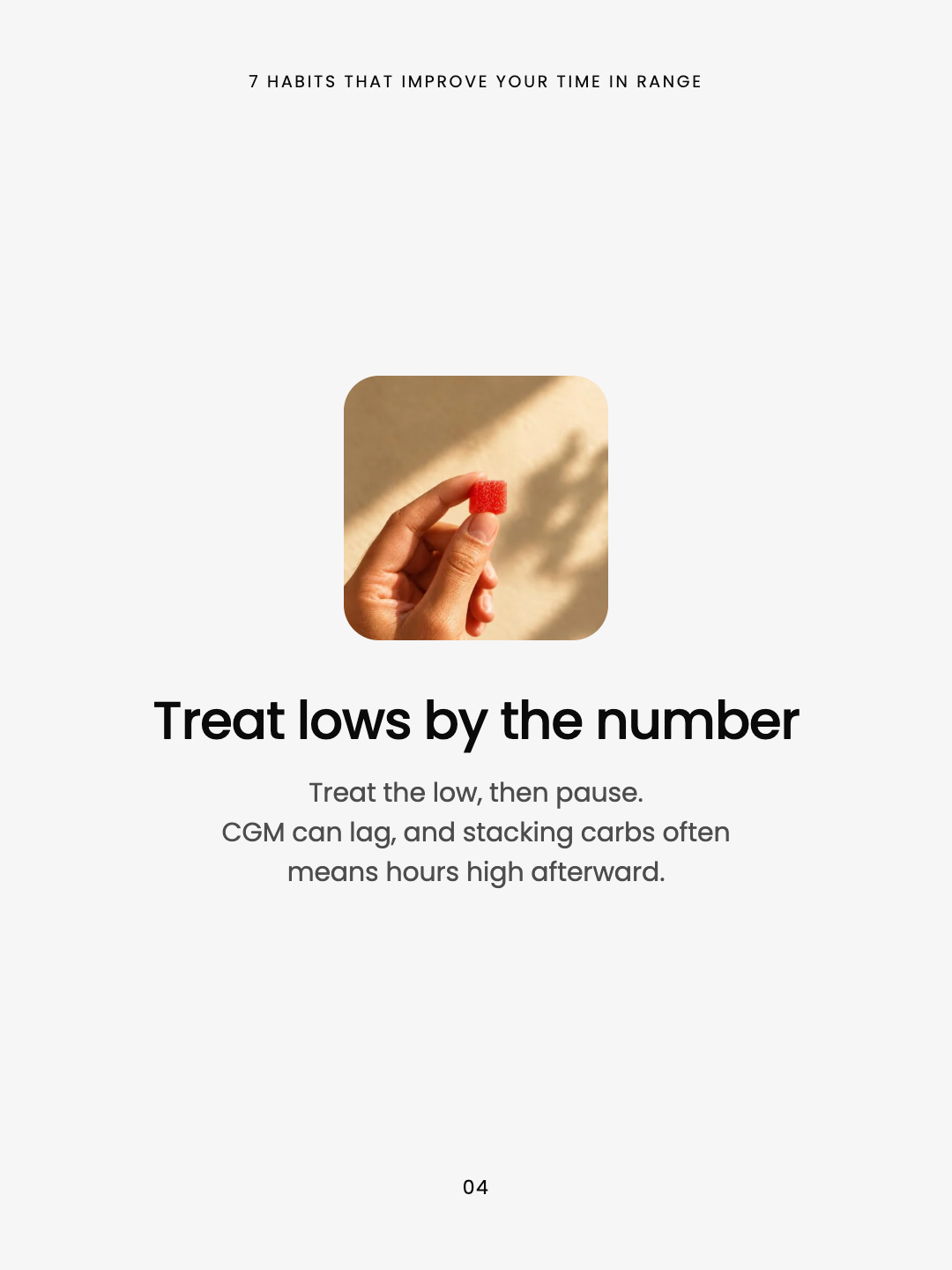
Carousel line: Treat the low, then pause. CGM can lag, and stacking carbs often means hours high afterward.
When glucose is low, the urge is to keep eating until you feel safe. Interstitial CGM readings can lag blood glucose, so the number may still look low after you have already treated. Stacking more carbohydrate “just in case” is a common path from a low into hours of high readings afterward.
Use the low treatment your care team taught you. Then pause long enough to see the response before treating again. Do not invent a gram recipe from this article. Official CGM or pump alerts stay your safety net; companion glances can lag further.
ADA Standards of Care define Level 1 hypoglycemia as glucose below 3.9 mmol/L, with more severe categories below that and when assistance is needed. Thresholds and treatment plans are personal. Follow yours.
05 Go to bed at the same time
Carousel line: A rough night can blunt insulin sensitivity the next day. A steadier bedtime often shows up in your glucose before you feel it.
Sleep debt and irregular bedtimes can reduce insulin sensitivity. Many people notice next-day glucose looking “harder” before they admit how tired they are. Protecting a steadier bedtime is not glamorous. It is often visible on the overnight and morning curve.
You do not need a perfect sleep score. Aim for a bedtime window you can keep most nights, including weekends when you can.
06 Check your patterns once a week
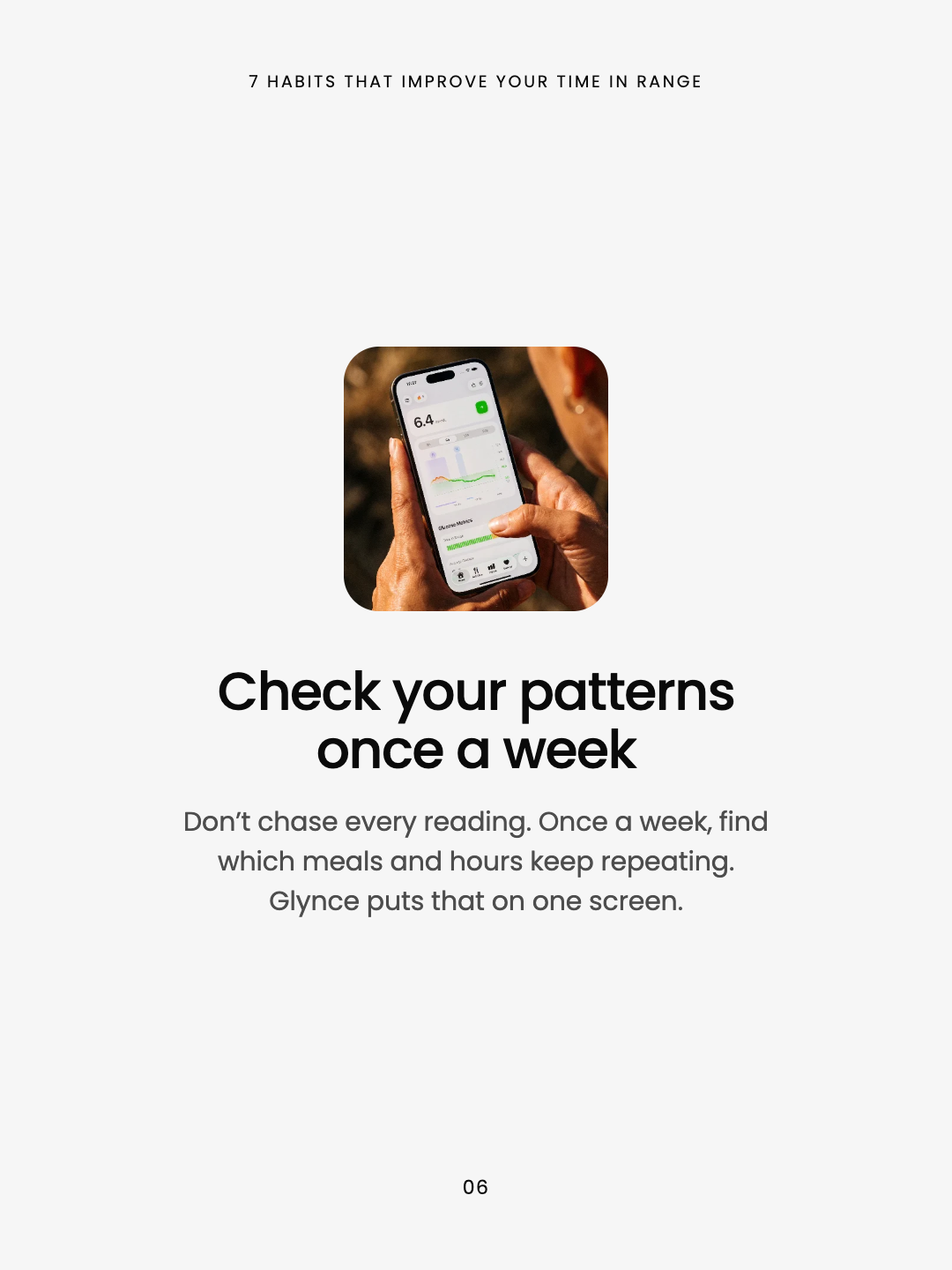
Carousel line: Don’t chase every reading. Once a week, find which meals and hours keep repeating. Glynce puts that on one screen.
Reacting to every CGM ping is exhausting and rarely teaches you much. Once a week, look for repeats: the same post-dinner climb, the same Friday takeaway curve, the same 03:00 drift. Patterns over isolated readings is the Glynce theme for a reason.
Bring those repeats to your care team as questions, not as self-prescribed dose changes. For reading shapes on the graph itself, see how to read your CGM graph.
07 Pick one goal and make it a behavior
Carousel line: Turn the goal into something you can actually do. Don’t stack all seven. Pick one, make it automatic, then add another.
“Get to 70% time in range” is a destination. It is not something you can complete on a single Tuesday. “Walk after dinner five days this week” is a behavior. Start from wherever your number is now. One habit from this list, two weeks, then the next.
Glynce streaks are built the same way: days you showed up, not days every reading sat in range. See daily goals.
How Glynce helps
Glynce is an iPhone app for adults with diabetes that puts glucose, food, and activity on one screen so weekly patterns are easier to see. It is deliberately not a dose calculator, and it is not a medical device or clinical tool.
- Log meals (and insulin if you record what you took) next to the glucose curve.
- Review the week instead of every ping.
- Keep official CGM and pump alerts as your safety layer. Live glances and widgets are companions and can lag.
Sensors: supported CGMs. Live surfaces: live glucose.
FAQ
Do I need all seven habits?
No. Stacking all seven at once is how habits fail. Pick one.
Is food order proven for adults with type 1?
There is supportive evidence, including a pediatric type 1 crossover study on protein/fat before carbohydrate. Adult responses vary. Use your CGM as the referee.
How long should I walk after dinner?
The carousel starts at ten minutes. More can help if you tolerate it and manage hypo risk with your care team. Consistency beats a heroic once-a-week hike.
What if pre-bolusing makes me low?
Stop experimenting alone. Timing that increases hypo risk needs a care-team conversation. This article is not telling you to pre-bolus a fixed number of minutes.
Will Glynce improve my time in range by itself?
No app raises TIR by magic. Glynce helps you see which habits and meals repeat so you and your care team can decide what to change.
What you can do this week
- Pick one habit from the list of seven.
- Decide what “done” looks like on a normal day (for example, carbs last at dinner, or a ten-minute walk).
- Run it for two weeks.
- Glance at the weekly pattern, not every alert.
- Only then add a second habit.
Download Glynce on the App Store. Connecting a CGM in Glynce is free.
Keep reading
- How to read your CGM graph
- Why blood sugar rises hours after eating
- Daily goals and streaks
- Supported CGMs
Disclaimer
This article is educational and is not medical advice. It is not a dosing guide, not insulin-timing instructions for your personal regimen, and not a hypoglycemia treatment protocol. Always follow the plan from your diabetes care team before changing insulin timing, food strategies, activity, or low treatment. Glynce helps you see patterns in your own data. It does not recommend, calculate, or decide insulin doses. Glynce is not a medical device or clinical tool, and it does not replace official CGM or pump alerts.
Sources
- Faber et al., 2018. Food order and postprandial glucose in children with type 1 diabetes (PubMed)
- Engeroff et al., 2023. Pre- vs post-meal exercise and postprandial glucose (systematic review / meta-analysis)
- ADA Standards of Care 2026: Glycemic Goals, Hypoglycemia, and Hyperglycemic Crises
- How to read your CGM graph (Glynce)