You went to bed in range, skipped the bedtime snack, and slept through the night. Yet your CGM still greets you with a high reading. Sometime before sunrise your glucose quietly started climbing, and by the time your alarm went off it was well above where you expected it to be.
If waking up with high blood sugar sounds familiar, you've probably met the dawn phenomenon. It's one of the most common reasons for morning high blood sugar in type 1 diabetes, and it affects more than half of people who live with T1D. In most cases it has almost nothing to do with what you did the night before.
Quick answer
The dawn phenomenon is a natural rise in blood sugar that usually happens between 3 a.m. and 8 a.m. Hormones like growth hormone and cortisol signal your liver to release glucose before you wake. In type 1 diabetes, there's no automatic insulin response to match that release, so glucose gradually rises overnight. The best way to confirm the pattern is to review several nights of CGM data rather than react to a single morning.
Although the dawn phenomenon can also affect people with type 2 diabetes, this article focuses on type 1 diabetes and how the pattern shows up when you use continuous glucose monitoring (CGM).
In this article
- How to recognize the dawn phenomenon on your CGM
- Signs you might be experiencing it
- How common is it?
- Why blood sugar rises before you wake
- Dawn phenomenon vs. Somogyi effect
- How to confirm what you're seeing
- What to do about it
- Can you prevent it?
- FAQ
How to recognize the dawn phenomenon on your CGM
The dawn phenomenon has a characteristic pattern on a CGM, and once you've seen it a few times it's easy to identify.
Look at the overnight trace. Your glucose holds steady or drifts gently down for the first stretch of the night. Then, usually sometime after 3 a.m., it begins a slow, steady climb that carries you into the morning. Rather than a spike, it's a gradual rise in your overnight glucose levels that's often still going when your alarm goes off.
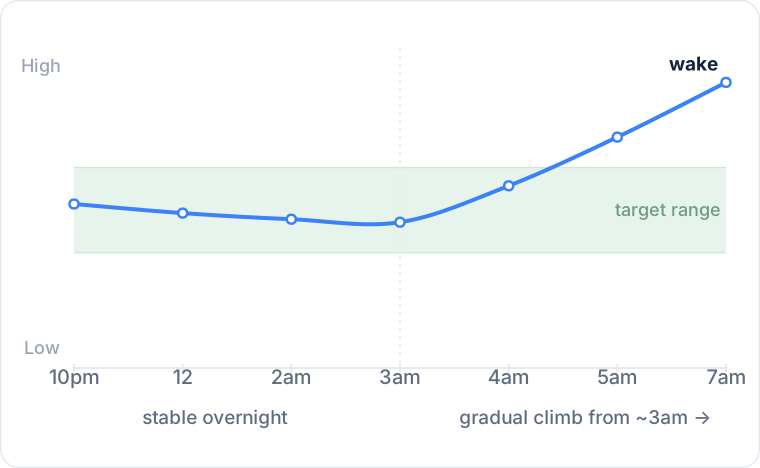
The key word is gradual. A sharp jump at 1 a.m. after a late curry is your dinner, not your hormones. The dawn phenomenon builds slowly over a few hours, and it tends to show up on plenty of mornings rather than just once. That repetition is the real tell, and it's the reason a single early morning high proves so little on its own.
Signs you might be experiencing the dawn phenomenon
Beyond waking with high blood sugar, a few patterns tend to point toward the dawn phenomenon:
- Higher fasting glucose in the morning despite going to bed in range.
- The same morning rise showing up several days a week, not just once.
- A gradual overnight climb on your CGM, usually starting after 3 a.m.
- Needing more insulin in the early morning than you do earlier in the night.
One thing that surprises people is that most of the time there are no physical symptoms at all. You won't necessarily feel the overnight rise, and you may wake up feeling completely normal. The CGM usually tells the story before your body does, which is why continuous data changed how this pattern gets spotted.
How common is the dawn phenomenon?
Studies suggest the dawn phenomenon affects more than half of people with type 1 diabetes, though estimates vary depending on how it's defined and where the threshold for a "rise" is set. It's common enough that if you see repeated morning highs, it's one of the first explanations worth checking.
Part of why the numbers move around is measurement. Because a CGM records glucose continuously overnight, the pattern is far easier to identify today than it was when the only option was setting an alarm for a 3 a.m. finger-stick. Continuous data is also why more people now notice a rise they never knew they had.
Why your body raises glucose before sunrise
This is a normal biological process, not a malfunction.
In the hours before you wake, your body starts preparing for the day. Part of that preparation is a coordinated release of hormones that work against insulin, mainly growth hormone and cortisol, with support from glucagon and adrenaline. Their job is to make sure you have fuel ready the moment you get up.
They do that by signaling your liver. Your liver stores glucose as glycogen and releases it on demand, and when those pre-dawn hormones send the signal, it adds glucose to your bloodstream so your muscles and brain have energy before breakfast. In a body that makes its own insulin, the pancreas releases a matching dose and the whole exchange goes unnoticed. Blood sugar barely moves.
Type 1 diabetes removes that automatic reply. The glucose still arrives on schedule, but there's no built-in insulin to meet it, and your basal insulin is often at its weakest by early morning. So your fasting blood sugar rises. It's a normal wake-up signal with nothing to balance it, not a sign that your management slipped.
The sleep connection: why these hormones peak overnight
The timing isn't random. Growth hormone is released in pulses, and one of the largest pulses typically occurs during slow-wave (deep) sleep, usually within the first few hours after you fall asleep. The exact timing varies with age, sleep quality, and individual physiology. It raises glucose by prompting the liver to produce more and by making your tissues temporarily less sensitive to insulin, an effect that can linger for hours and land squarely in the early morning window.
Cortisol runs on a separate clock. It follows your circadian rhythm, your body's roughly 24-hour internal clock, dropping to its lowest around midnight and then climbing through the second half of the night to peak shortly after you wake. That built-in rise, sometimes called the cortisol awakening response, nudges glucose production upward at exactly the time your basal insulin is thinning out. Because growth hormone and cortisol peak on overlapping schedules, early morning blood sugar, rather than midnight blood sugar, is when the climb tends to show. Research going back to the first descriptions of the effect has tied the nocturnal surge in growth hormone to this rise in type 1 diabetes.
The mix-ups worth clearing up
Two misunderstandings send people down the wrong path.
The first is self-blame. A morning high after a clean night feels like a personal failure, so people start restricting dinner, skipping their evening snack, or stacking correction doses before bed. None of that addresses a liver responding to hormones, and some of it can set you up for an overnight low.
The second is a lookalike traditionally called the Somogyi effect, a rebound rise in glucose after an overnight low. The idea is that if you drop too low while you're asleep, your body releases those same blood-sugar-raising hormones to rescue you, and you wake up high as a result. It looks identical at 7 a.m., but the cause is the opposite: too much overnight insulin rather than too little.
Worth knowing: the Somogyi effect is widely taught in diabetes education, but the evidence that it commonly explains morning highs is limited. Many specialists now think persistent morning highs are more often down to the dawn phenomenon or simply not enough overnight insulin than to a rebound from a nocturnal low. Either way, the practical move is the same, and it's one CGM makes easy: look at your overnight data instead of guessing, because a rebound and a hormone-driven rise call for opposite fixes.
Dawn phenomenon vs. Somogyi effect at a glance
| Dawn phenomenon | Somogyi effect | |
|---|---|---|
| Overnight glucose (2 to 3 a.m.) | Stable or slowly rising | Drops low |
| Morning glucose | High | High |
| Underlying cause | Blood-sugar-raising hormones | Rebound from an overnight low |
| Basal insulin | Often too little overnight | Often too much overnight |
| Typical fix | Increase early-morning basal | Prevent the overnight low |
How to confirm what you're actually looking at
The tool that reveals the pattern is the same one that lets you diagnose it. You don't need a 3 a.m. alarm and a finger-prick the way people did before continuous monitoring. Your overnight glucose is already recorded; you just have to read it well.
Focus on the small hours, roughly 2 to 3 a.m., and check what your CGM did there:
- Stable or climbing all the way through to morning points to the dawn phenomenon.
- A dip into or near the low range, followed by a sharp climb, points to an overnight low and a rebound.
Then widen the lens. A single morning glucose spike proves nothing. What you're looking for is a repeating shape, and the clearest way to see it is to compare several nights at once. Many people overlay three to five nights of overnight data and look for the common thread. When four out of five nights show the same slow climb starting around the same time, you're no longer guessing. When only one night stands out, you've probably found a one-off.
Why one high morning doesn't prove the dawn phenomenon
It's tempting to explain every unexplained morning high as the dawn phenomenon, but that's rarely accurate.
Stress, illness, alcohol, a late dinner, delayed digestion, inaccurate carb counting, shifting insulin needs, or even a poor night's sleep can all produce a similar result. For instance, delayed glucose spikes after high-fat, high-protein meals can drift up late into the night and mimic the pattern, and alcohol can push your levels around in either direction. Those are meal effects, not hormonal ones, and the overnight curve usually shows the difference.
That's why diabetes specialists focus on patterns rather than isolated readings. If the same gradual rise appears over several nights under similar conditions, you're much more likely to be looking at the dawn phenomenon than a one-off event. A repeating pattern is what justifies a change to your insulin, whereas a single reading rarely does.
What to do about it, and what to leave alone
First, the safety note: the dawn phenomenon lives in your basal insulin, and overnight basal is the setting where mistakes carry the most risk. Everything below is a conversation to have with your diabetes team, not a solo experiment.
Start with what not to do. Don't cut your dinner carbs, don't add a large bedtime correction, and don't change two things at once. Those moves tend to trade a morning high for a 4 a.m. low, which is a far worse outcome. And don't act on one bad morning. Give it several nights.
When the pattern is confirmed, pump users and MDI users have different tools:
- Pump users have the most precise option. You can program a higher basal rate for just the early-morning window, so extra insulin arrives as the liver ramps up and eases off before you wake. It's targeted and reversible, which is why the dawn phenomenon is often easier to manage on a pump.
- MDI (injection) users rely on a longer-acting basal, so the adjustments are blunter. The timing of your basal shot can change when its coverage runs thin toward morning, and for some people a split basal regimen smooths the overnight profile. This takes more collaboration with your team to get right.
- Automated insulin delivery systems handle the dawn phenomenon particularly well. A hybrid closed-loop can raise insulin in the early hours based on your live CGM data while you sleep through it.
- Evening habits play a smaller, supporting role. Large high-fat dinners and alcohol can amplify the morning rise for some people, so they're worth watching, but they rarely explain the whole pattern.
Contact your care team when the morning highs are consistent, when your fasting blood sugar is creeping higher over time, or when nothing you try together moves the needle. That's the signal to review your overnight basal properly rather than keep improvising.
Can you prevent the dawn phenomenon?
Not completely.
Because the dawn phenomenon is driven by your body's natural hormone cycle, it can't simply be switched off. Rather than trying to stop the hormone release, the goal is to make sure enough insulin is available when it happens.
Depending on your treatment, that might involve:
- adjusting the timing or rate of your overnight basal
- using a temporary basal rate in the early-morning hours (on a pump)
- reviewing the timing of your long-acting insulin (on MDI)
- letting a hybrid closed-loop system respond to the rise automatically
The right approach depends on your insulin regimen, so any change should be made with your diabetes team rather than on your own.
How Glynce helps you see the pattern
The biology is well understood. The challenge is recognizing the pattern consistently, because a single morning number tells you almost nothing and the answer only appears when you compare night after night.
The easiest way to spot the dawn phenomenon is to view several nights of overnight glucose side by side and look for the climb that repeats. That's the view Glynce is designed to provide. Your overnight curves sit together in one place, so instead of judging last night's graph in isolation, you can scroll back and see whether the same early-morning climb keeps reappearing. Four mornings behaving the same way turns a vague suspicion into something concrete. Because the same overnight trace also shows the pre-dawn dip that signals a rebound, you can distinguish the dawn phenomenon from an overnight low without guessing, which is often the difference between the right fix and the wrong one. When you sit down with your care team, you arrive with the pattern in hand rather than a single alarming reading.
Frequently asked questions
Can people without diabetes have the dawn phenomenon?
The underlying hormone surge happens in everyone. Growth hormone and cortisol rise before waking regardless of whether you have diabetes. The difference is that a working pancreas releases just enough insulin to cover the extra glucose, so blood sugar stays flat. Without that automatic response, the rise shows up as a morning high.
How long does the dawn phenomenon last?
Within a given night, the rise typically runs from the early hours until an hour or two after you wake, then flattens once you're up and moving. As a pattern, it isn't necessarily permanent. It can come and go with changes in insulin needs, hormones, sleep, and life stage, which is one reason it often shifts during puberty, pregnancy, or periods of stress.
Is the dawn phenomenon the same as the Somogyi effect?
No. Both leave you high in the morning, but the dawn phenomenon is a hormone-driven rise on stable overnight glucose, while the Somogyi effect is a rebound after an overnight low. The Somogyi effect is widely taught but appears to be less common than once thought, so persistent morning highs are more often the dawn phenomenon or too little overnight insulin. Your 2 to 3 a.m. CGM reading is the fastest way to tell them apart.
Can eating before bed cause high morning blood sugar?
It can, but that's usually a separate issue from the dawn phenomenon. A late or high-fat, high-protein meal can cause a delayed rise that drifts up overnight, and slow-digesting food can still be releasing glucose in the early hours. On your CGM, a meal effect usually starts earlier and tracks back to dinner, while the dawn phenomenon begins after 3 a.m. on nights you ate normally.
Should I correct a high blood sugar right after waking?
Correcting a genuine morning high is reasonable, but do it based on your team's guidance and watch for insulin already on board. The bigger point is diagnostic: don't let one high morning push you into changing your basal on the spot. Track the pattern across several mornings first, then adjust with your care team.
What you can do starting tonight
You don't need a plan overnight. You need a few nights of honest data.
For the next three or four mornings, resist the urge to change anything. Just watch. Each day, open your overnight curve and check two things: what your glucose did around 2 to 3 a.m., and whether a slow climb into the morning keeps showing up. If you can, view those nights side by side and see whether they match.
By the end of the week you'll know which pattern you're dealing with, a genuine dawn phenomenon or an overnight rebound in disguise. That clarity, more than any single tweak, is what turns an unexplained morning high into a problem you and your care team can actually solve.
Keep reading
- How to Read Your CGM: A Guide to Common Glucose Patterns. The overview this pattern belongs to.
- Delayed glucose spikes after high-fat, high-protein meals. Why a "perfect" dinner can raise your blood sugar hours later.
This article is for education, not medical advice. Overnight insulin changes carry a real risk of hypoglycemia. Talk to your diabetes care team before adjusting your basal doses or timing.
Sources
- Dawn Phenomenon: What It Is, Causes, Symptoms & Treatment. Cleveland Clinic.
- High Morning Blood Glucose. American Diabetes Association.
- Schmidt MI, et al. The dawn phenomenon, an early morning glucose rise: implications for diabetic intraday blood glucose variation. Diabetes Care, 1981.
- Campbell PJ, et al. Role of growth hormone in the pathogenesis of the dawn phenomenon in insulin-dependent diabetes mellitus. PubMed.
- Monnier L, et al. Thirty years of research on the dawn phenomenon: lessons to optimize blood glucose control in diabetes. Diabetes Care, 2013.